

Reading time: 8 minutes
Deploying an ERP system within a company is a transformative project that impacts processes, work methods, and employee habits. The same is true for any new HRIS project. To ensure the success of this transformative project, user buy-in is essential. Without this key element, the risks of delays, errors, or suboptimal use increase significantly. In this article, we explore why change management is essential, the pitfalls to avoid, and best practices for ensuring the success of your ERP or HRIS project.
Why is change management essential?
When implementing the project, it is important to plan for change management. This phase allows you to address resistance to change and take the appropriate supportive actions at each stage of the change process. This approach is therefore a long-term one, beginning well before the project starts and continuing for several weeks after the launch.
For users:
Implementing ERP software or human resources software often involves significant changes to work habits. Change management helps guide users through this transition by offering them:
- A Better Understanding: Users understand the project’s objectives, its benefits, and its positive impact on their daily work.
- Greater involvement: They feel like they are an integral part of the project, which motivates them to contribute actively.
- Enhanced skills: Targeted training courses enable users to quickly master the tool’s new features.
- An enhanced experience: By understanding the benefits of ERP or HRIS systems, they can make the most of them to increase their efficiency at work.
For the company:
Change management helps structure the ERP or HRIS project by:
- Facilitating thorough planning: with clear phases of collective brainstorming, testing, and data review.
- Maximizing Return on Investment: A successfully implemented ERP/HRIS system improves the efficiency of internal processes and strategic decision-making.
- Minimizing risks: Change management reduces delays, errors, and conflicts caused by resistance to change.
The Risks of Low User Adherence
Poor management of user onboarding can lead to many negative consequences, such as:
- Delays in data entry: Employees are not submitting their activity reports, expense reports, or absence reports on time.
- Functional errors: Incorrect use of the ERP or HRIS system can lead to issues with deal approval or invoicing.
- Incomplete data: Customer, employee, or project records are not filled out correctly.
- Lack of understanding of strategic indicators: Decisions are made based on incomplete or inaccurate information.
- Processing Outside the ERP /HRIS: Some teams bypass the system, creating inconsistent and unshared data.
- Lack of progress: The new features introduced by the updates are not being adopted.
Identifying and Overcoming Resistance to Change
Why is there resistance?
Each person reacts differently to change. Some see new procedures as opportunities, while others experience a sense of stress or insecurity. These differences manifest themselves in various ways:
- Inertia: A lack of response or a passive refusal to participate.
- Argumentation: Verbal opposition or the highlighting of potential obstacles.
- Revolt: An active rejection of the new procedures.
- Sabotage: Harmful actions intended to undermine the project.
The Stages of Grief According to Elisabeth Kübler-Ross’s Model
The Kübler-Ross model describes the different stages individuals go through when facing change:
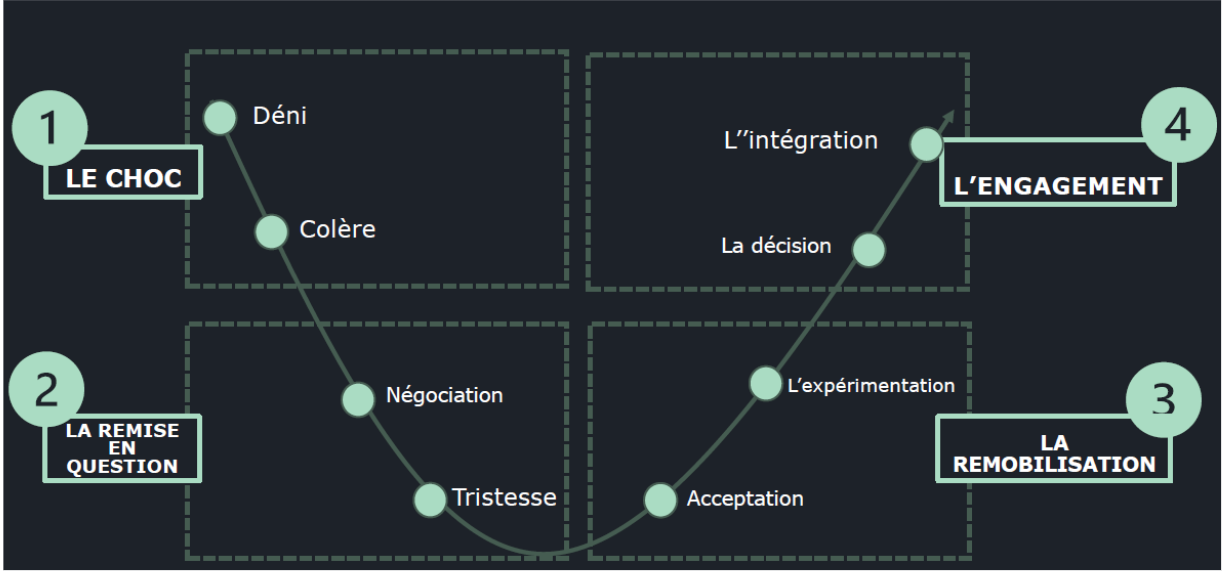
- Shock: An initial reaction of surprise or bewilderment. The individual perceives the new situation as a shock. Initially adopting a stance of denial, he doubts his ability to adapt to this change. He expresses his frustration.
- Denial: The refusal to admit that change is necessary.
- Anger: A form of frustration that can turn against the project or those in charge of it.
- La remise en question : l’individu prend pleinement conscience du changement, et peut se sentir impuissant, résigné.
- Negotiations: An attempt to maintain the status quo.
- Sadness: A feeling of loss or helplessness.
- La remobilisation : l’individu sort de la zone descendante. Il adopte un autre point de vue sur la nouveauté et détecte les avantages.
- Acceptance: Embracing change and committing to the new reality.
- Experimentation
- L’engagement : le changement est intégré et compris. L’individu a retrouvé de la confiance et de la sérénité. Il peut désormais se tourner vers l’avenir.
- Decision
- Integration
Understanding these steps helps tailor support strategies to users’ needs.
You can positively influence each of these phases as the project progresses:
- Make sure to communicate effectively well in advance of the project; explain the reasons behind this decision and the benefits for employees and the company… Lay the groundwork for dialogue.
- Provide general information, followed by training sessions organized by job function.
- Communicate positively about small victories.
- Create a project group, appoint project leads, and highlight the new skills acquired.
Participating in this support phase will help structure your project through group brainstorming sessions, testing, and data migration—and you’re sure to reap the benefits of the new solution!
Bad Practices to Avoid at All Costs
- No support at launch.
- Lack of user training tailored to different roles.
- Incomplete or low-quality data import.
- Opening too many modules at the same time, without setting priorities.
- Lack of managers or tool coordinators.
- No culture of continuous improvement.
Here you will find a more detailed list of possible reasons why an ERP or HRIS project might fail.
Best Practices for Successful Change Management
Appoint key change management leads
Identify a project manager and key users (also known as super users) who will serve as points of contact for users. These individuals must be proficient in the software and able to train and assist their colleagues in using it.
Create a steering committee
A steering committee provides an overview of the project. It facilitates communication among teams, identifies functional requirements, and oversees the testing and training phases.
Organize regular workshops
Plan best-practice workshops tailored to each job function to address users’ specific needs. These opportunities for discussion help foster buy-in and autonomy.
Prepare for user onboarding
A structured onboarding program is essential for introducing users to the new software. Include training sessions tailored to their roles and provide accessible resources to help them get started easily.
Developing Independence
Encourage user autonomy through guides, tutorials, and personalized support from a Customer Success Manager. At Veryswing, we offer tailored support to ensure the success of your projects.
Promote individual recognition
You can implement a user certification process to encourage every employee to get involved in the project. In addition, consider a rewards system to recognize the users who are most committed to adopting the new tool.
Continuous Improvement: A Winning Strategy
Organize periodic monitoring and evaluation
Once your ERP or HRMS has been deployed, it is crucial to monitor user adoption and satisfaction. Regular surveys help identify areas for improvement and address new needs.
Provide ongoing training
Software updates and enhancements require regular training to ensure users maintain a high level of proficiency. At Veryswing, we regularly host webinars on new features to explain them in detail. We also offer customized training programs designed to closely align with your business needs.
Encourage innovation
Involving users in the tool’s development boosts their motivation and ensures that the tool remains aligned with the company’s actual needs. With Veryswing, you can submit your own ideas for improvement through the Fit Your Needs tool.
Share best practices
Veryswing software customers can join the VS Club, our software user community. Within this community, you can share best practices and draw inspiration from how other Veryswing customers use our software. The VS Club meets in person at least once a year: this is an opportunity for us to inform users about new features and present the software development roadmap. Take advantage of this event to gather as much information as possible and then share it directly with your colleagues.
What do you need to keep in mind to ensure the success of your ERP/HRIS project?
Change management is essential to the successful implementation of an ERP system. By investing in tailored support and involving your teams, you’ll maximize your project’s chances of success while getting the most out of Veryswing’s solutions. Follow our news and contact our team to take advantage of our latest offerings and personalized advice!
How can Veryswing help you implement your ERP/HRIS?
When you launch an ERP/HRIS project with Veryswing, you’ll have the support of a team dedicated to your project. Consultants and Customer Success Managers will work alongside you to plan each step and engage your employees. Since our founding, we’ve helped more than 500 companies implement their new ERP systems. With our vsa, vse, and vsp software, we specialize in optimizing business processes for service, consulting, and umbrella employement companies.
To learn how the software implementation process works with Veryswing, schedule an appointment here to speak directly with one of our consultants.