


Reading time: 12 minutes
Finding the right consultant for the right assignment at the right time—and before the gap between contracts begins. That’s the promise of well-managed staffing. Here’s how to make it happen.
In IT service companies, the effectiveness of staffing is directly linked to profitability. Every unassigned consultant represents a payroll cost without corresponding revenue. Every under-staffed assignment risks leading to customer dissatisfaction, schedule delays, or even the loss of a contract.
Yet, in many digital services firms, the staffing process remains fragmented. Sales representatives manage their portfolios independently, recruiters search for candidates without knowing the pipeline, and HR only finds out about availability at the last minute. The result: avoidable gaps between contracts, missed opportunities, and frustrated consultants.
This guide outlines the key steps in a structured staffing process, the pitfalls to avoid, and how to ensure effective collaboration among your sales, recruitment, and HR teams.
Staffing in IT service companies: What Are We Talking About?
Staffing refers to the set of processes that enable usto assign the right consultant to the right assignment at the right time. It’s not just about finding an available candidate.
Rather, it involves a constant balancing act between consultants’ skills, their career aspirations, clients’ needs, and the IT service companies’ business constraints.
In the IT service companies, there are two distinct situations:
- Reactive staffing: A client need is identified. The digital services firm searches among its available consultants or those between contracts to find those who match the required profile.
- Proactive staffing: The IT services firm anticipates the end of an assignment and begins sourcing the next one even before the consultant is released from the current assignment. This is the key to avoiding gaps between assignments.
According to industry data reported by the Syntec federation, a healthy gap between contracts ranges from 5 to 10 percent. Above 15%, the impact on margins is significant. Above 20%, the very sustainability of the organization may be at risk. Effective staffing is therefore the first line of defense against this risk.
The 5 Steps of an Effective Staffing Process
Step 1 – Map Skills in Real Time
It all starts with a clear and up-to-date picture of what each of your consultants is capable of doing:
- Technical Skills
- Certifications
- Industry Expertise
- Languages
- Accepted assignment arrangements (time and materials, fixed-price, remote work, travel)
This information should be accessible in real time, not buried in a PDF resume that was shared via email six months ago.
What needs to be implemented: a centralized competency framework, updated after each assignment or certification, that can be accessed by all sales and HR teams without having to go through a manager.
Step 2 – Check availability before the end of the assignment
The golden rule of effective staffing: never find out that a consultant is available only after they’re already available. This requires having visibility into upcoming assignment end dates and starting the search for the next assignment early.
Careful management of this transition is a topic in its own right, which we cover in detail in our dedicated article: Transition Periods at IT Service Companies: How to Anticipate and Better Manage Them.
Step 3 – Accurately Identify the Customer’s Need
Before launching a search, the job description must be complete: required vs. desired skills, location, estimated duration, billing method, start date, project context, and client contact. An incomplete job description results in proposals that miss the mark and unnecessarily prolongs the process.
What needs to be implemented: a standardized requirements form template, filled out by the business engineer and automatically shared with the staffing manager and the recruiter as soon as it is approved.
Step 4 – Match and Make an Offer on Time
This is the heart of staffing: matching client needs with the skills database to identify the most suitable candidates. Speed is critical. A client who has to wait 72 hours for an initial proposal may have already contacted a competitor.
What needs to be implemented: a matching engine that cross-references a consultant’s skills, availability, location, and preferences. The goal: to propose 2 to 3 relevant profiles within 24 hours for standard needs.
Step 5 – Track and Close the Loop
Whether or not a consultant is assigned, the process must be documented.
- What profile was proposed?
- What was the customer’s reaction?
- Why wasn’t the profile selected?
This information is valuable for refining future proposals and improving the conversion rate.
What needs to be implemented: a system for tracking proposals with status updates (in progress, accepted, rejected, pending) and systematic feedback from the sales representative to the staffing manager within 48 hours.
What a Structured Staffing Cycle Can Achieve
- The average time to provide a quote has been reduced to less than 24 hours for standard requests.
- The between-contract rate was kept below critical thresholds thanks to proactive planning.
- An improved conversion rate for proposals thanks to tracking customer rejections.
- A better experience for consultants: kept informed in advance and involved in assignment decisions.
The Key Role of Collaboration Between Sales, Recruiters, and HR
That’s often where the problem lies. In many digital services companies, these three functions operate in silos, using different tools, with priorities that are sometimes at odds with one another, and little shared visibility.
The Sales Representative (Sales Engineer / Business Manager)
His role in staffing: identifying client needs, defining job requirements, and proposing candidate profiles. He is the one who manages the client relationship and, as a result, knows what the client truly values beyond the job description.
His recurring problem: he isn’t very familiar with the available internal talent pool. He ends up looking for candidates externally, even though there are qualified consultants between contracts at his own digital services firm, simply because he lacks real-time visibility into their availability.
The Recruiter
Their role in staffing: sourcing external candidates when the internal talent pool is insufficient. However, their effectiveness depends directly on the quality of the job description provided by the sales representative.
His recurring problem: he sometimes hires without knowing the sales pipeline. He hires consultants whose profiles don’t match current or upcoming assignments, resulting in a gap between contracts starting on the very first day of the contract.
The HR/Staffing Manager
His role in staffing: keeping the skills database up to date, tracking availability, and ensuring that each consultant has a clear understanding of their assignment.
His recurring problem: he is often notified too late when assignments end, has to find available staff at the last minute, and spends most of his time following up rather than optimizing assignments.
What Seamless Collaboration Actually Changes
When these three functions share the same database (profiles, availability, sales pipeline), the impact is immediate:
- The sales representative can propose a suitable internal candidate within 24 hours.
- The recruiter focuses their search on the profiles that are actually missing.
- HR anticipates the end of assignments and initiates staffing actions before the consultant is placed on the bench.
- Consultants have a smoother experience: informed in advance and involved in assignment decisions, they experience fewer disruptions between projects.
The Most Common Staffing Mistakes in IT Service Companies
- Lack of a formalized process: without defined steps, a standardized request form, or a target response time, each assignment starts from scratch. This is the number one cause of excessive delays and, ultimately, avoidable gaps between contracts.
- Lack of awareness of the internal talent pool: Sales representatives are unaware of the specific skills of their consultants, particularly those who have developed new skills since their last assignment. As a result, relevant internal candidates slip under the radar.
- Incomplete requirements documents: Poorly defined requirements lead to unsuitable proposals, unnecessary back-and-forth, and longer lead times.
- Recruitment Disconnected from the Pipeline: Hiring for highly sought-after tech roles is taking place without verifying whether a corresponding assignment is in the short-term sales pipeline.
- Lack of customer feedback: Not knowing why a profile was rejected makes it impossible to improve future proposals.
- Ignoring consultants’ aspirations: Systematically assigning assignments without taking consultants’ preferences into account leads to dissatisfaction and, ultimately, turnover.
Key Performance Indicators (KPIs) to Track for Effective Staffing Management
Like any operational process, staffing must be guided by metrics. These KPIs are part of the set of digital services KPIs you should track to manage your business.
| KPI | What it measures | Alert Threshold |
|---|---|---|
| Labor Force Participation Rate (LFPR) | Percentage of billable days / working days excluding holidays | Target > 80% – Alert < 70% |
| Inter-contract rate | Percentage of days on the bench / working days excluding holidays | Healthy < 8% – Critical > 15% |
| Average staffing time | Days between the expression of the need and the assignment | Target: < 10 business days |
| Proposal Conversion Rate | Percentage of proposals accepted by clients | IT service companies Benchmark: 25–40% |
| Mission Renewal Rate | Percentage of extended assignments vs. completed assignments | Customer Satisfaction Indicator |
| Average Forecast Horizon | How far in advance is the next mission scheduled before the current one ends? | Goal: > 30 days |
How VSActivity Streamlines Collaboration Between Sales and HR Through Matching
The disconnect between sales and HR is often a matter of tools.
When each department uses its own tool, data doesn’t flow.
That’s exactly the problem that VSActivity solves by centralizing sales, recruitment, and resource management in a single database shared in real time.
Resource-to-Business Matching: Find the Right Candidate in Just a Few Clicks
In the Opportunities module of VSActivity, as soon as a client need is entered, the matching feature displays candidates and internal and external employees whose profiles “match” the opportunity.
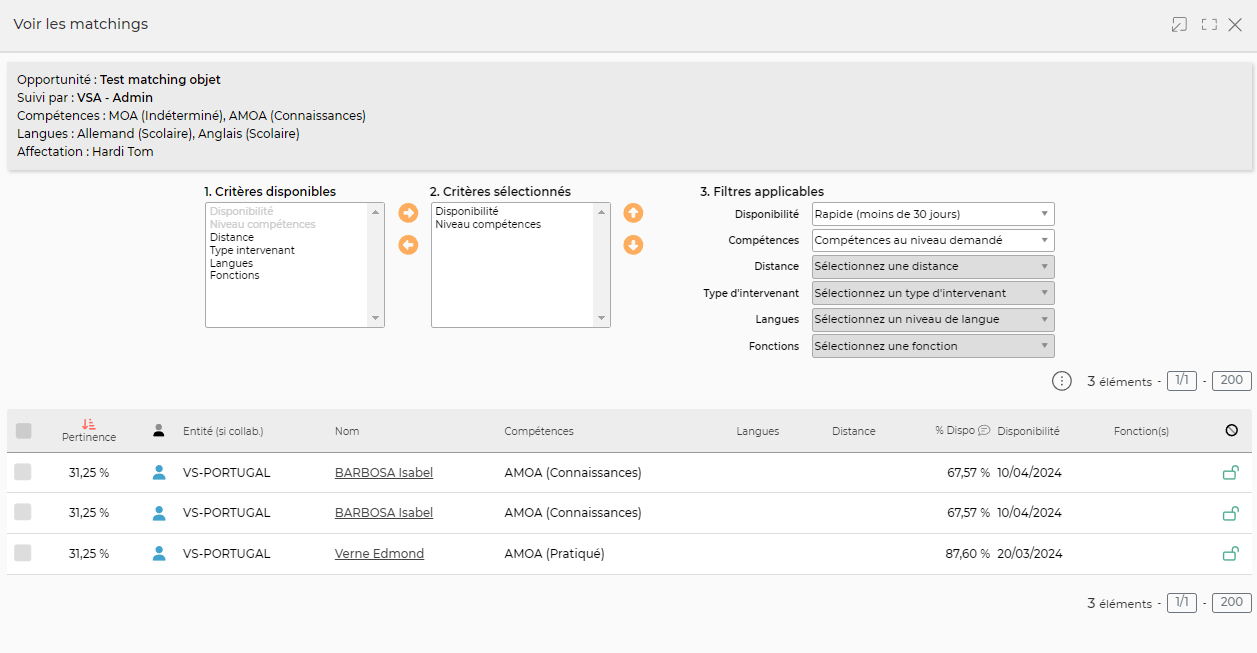
Sales representatives no longer need to send an email to HR to find out who is available, nor do they need to wait for a reply. They can see directly in their sales interface the profiles that match the client’s needs, along with their up-to-date skills, locations, and availability.
Concrete result: The time between receiving a client request and the first profile proposal can be reduced from several days to just a few hours.
A database shared by sales, recruitment, and HR
This marks a fundamental break from a siloed organizational structure. In VSActivity, the three functions have access to the same data in real time:
- The sales representative can see which consultants are available or will soon be available, filter by skill, industry, or location, and generate proposals directly from the deal.
- The recruiter reviews the sales pipeline to identify the profiles that are truly missing and focus their external search efforts where the internal talent pool is insufficient.
- The HR/staffing manager monitors the progress of assignments, views each consultant’s workload, and can proactively initiate staffing actions.
This continuous synchronization eliminates back-and-forth email exchanges, lost information, and decisions based on outdated data.
What the Sales/HR Collaboration in VSActivity Actually Changes
- Instant matching between a client’s needs and available resources (in-house staff, candidates, and subcontractors).
- Eliminating back-and-forth emails between sales and HR to identify candidates.
- Recruitment focused on actual vacancies, not on candidates already available internally.
- Shared dashboards: TACE, staffing rates, and pipeline data are available for all roles.
Manage Your Staffing with VSActivity
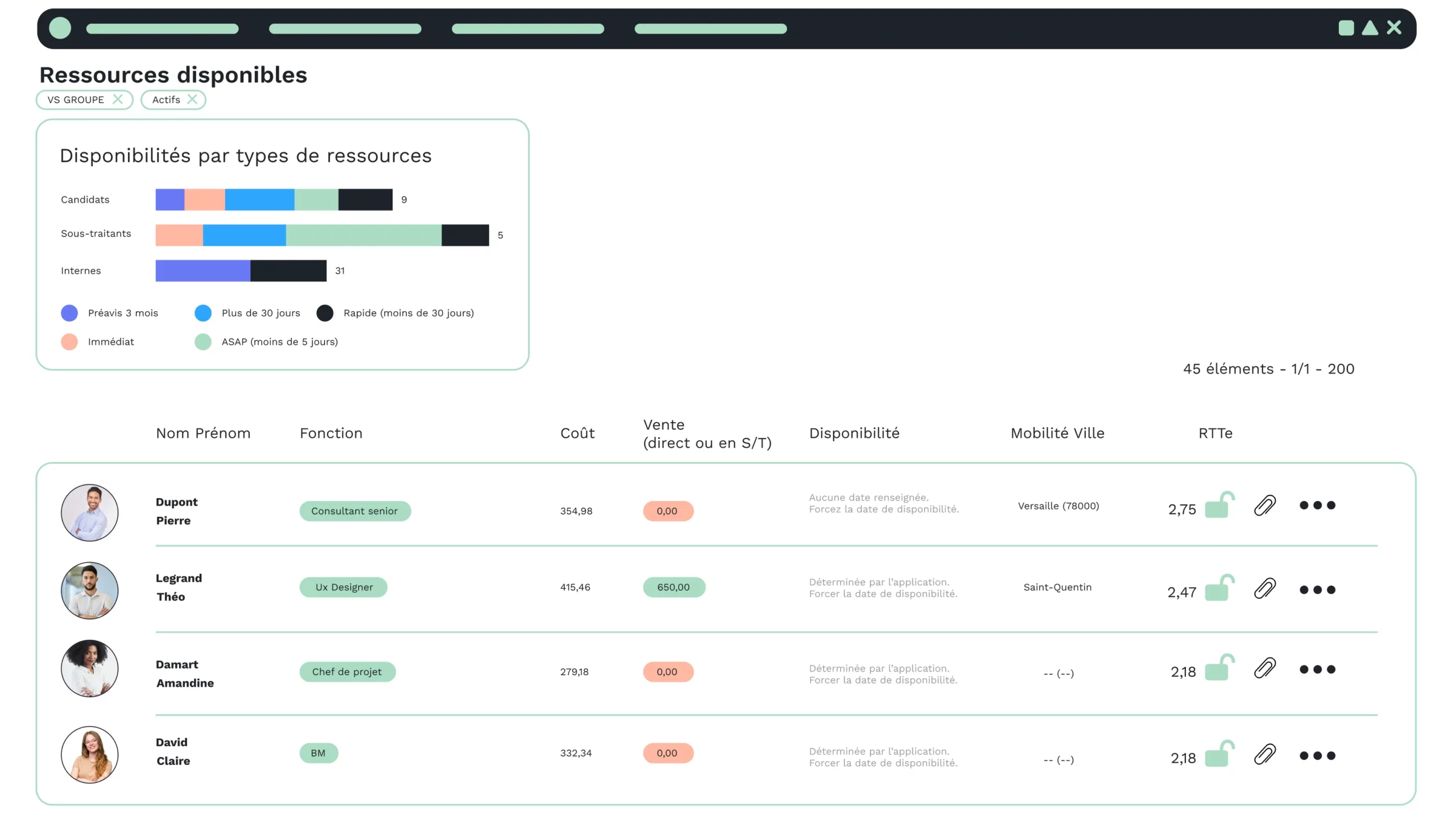
VSActivity is a SaaS ERP system designed specifically for digital services firms and consulting firms. Its resource-to-business matching module connects your sales, recruitment, and HR teams in real time via a shared database, ensuring that the right consultant is matched with the right client as quickly as possible.
FAQ – Frequently Asked Questions About Staffing in IT Service Companies
What is the difference between staffing and recruitment in IT service companies?
Recruitment involves attracting and hiring new consultants. Staffing, on the other hand, involves assigning consultants who are already on staff or in the process of being hired to available client projects. An IT services company can have an excellent recruitment process but poor staffing if the two functions are not coordinated.
What is the ideal rate of time between contracts for IT service companies?
A gap-between-contract rate of less than 8% is generally considered healthy. Between 8% and 15%, profitability begins to be affected. Above 15%, it’s a red flag. To learn how to manage gaps between contracts when they occur, check out our article: Gaps Between Contracts in IT Services Firms: How to Anticipate and Better Manage Them.
How can you measure the effectiveness of your staffing process?
Three indicators are particularly telling: the average staffing time (the time between receiving a client request and assigning a consultant— < ’s target is 10 business days), the proposal conversion rate (% of proposed candidates accepted by the client—IT service companies benchmark: 25–40%), and the inter-contract rate as a result of the entire process.
How can we involve consultants in the staffing process?
IT service providers that achieve the best results in staffing treat consultants as active participants in the process, not as resources to be placed. Specifically: they inform consultants in advance about available assignments, allow them to express their preferences, present them with 2–3 options whenever possible, and gather their feedback after each proposal.
What is resource-to-business matching in an ERP system for IT service companies?
Resource-to-business matching is a feature that, based on a client request form, automatically identifies the most suitable internal and external profiles (candidates, contractors) by cross-referencing skills, availability, and location. It eliminates the need for manual searches in Excel files or email inboxes, allowing sales representatives to propose a relevant candidate in just a few minutes rather than several days.