

Umbrella employment is based on a three-way relationship between the contractor,the umbrella company (EPS), and the client company. In this system, financial transparency is a fundamental pillar for building trust and fostering loyalty among your contractors.
And that’s where the activity account comes in!
This individual monitoring tool must be implemented by the umbrella company to manage each contractor. However, many umbrella companies underestimate this legal obligation. Some also struggle to comply with it effectively.
In this article, learn about:
- What is the activity account?
- What must it contain according to the law?
- What are the penalties for noncompliance?
- And most importantly, how can we implement it in a compliant and effective manner using digital tools?
What is the activity account under umbrella employement?
Definition and Legal Framework of the Activity Account in Umbrella Employment
The activity account is an individual financial tracking tool set up by the umbrella company for each contractor. It tracks all financial transactions related to the contractor’s work: client invoices, social security contributions, management fee, net pay, financial reserve, etc.
This requirement is set forth in two major pieces of legislation:
- Article L.1254-25 of the Labor Code, resulting from the ordinance of April 2, 2015: “The umbrella employement company shall establish and manage an activity account for each contractor. The contractor is informed once a month of the items posted to this account.”
- The collective bargaining agreement on umbrella employment dated March 22, 2017 (Article 18), which specifies the detailed content of the activity account and strengthens the employer’s transparency obligations.
To learn about all the requirements for managing an umbrella employement company, check out our comprehensive guide here.
IMPORTANT!
Do not confuse the activity account as defined above with the contractor’s activity report (CRA). The CRA is the document filled out each month by the contractor to report their days worked and assignments. The activity report provides data for the activity account, but they are indeed two separate documents.
Why is the activity account required?
The legislature imposed this requirement for several reasons:
- Financial transparency: The contractor must be able to understand how their turnover is converted into salary, what deductions are made, and at what rates.
- Traceability of cash flows: In the event of an audit (by URSSAF or the labor inspectorate) or a dispute, the activity account serves as proof of proper management of the umbrella company.
- Trust and Loyalty: A consultant who understands their compensation is a loyal consultant. Transparency is a key differentiator in the umbrella company market.
- Basis for calculating the financial reserve: The activity account is used to track the mandatory contributions to the reserve (10% of base salary) and any withdrawals from it.
What must the activity account include? The 7 required elements
Article L.1254-25 of the Labor Code and the collective bargaining agreement specifically list the seven items that the umbrella company must provide to the contractor each month.
Payments from the client company
The activity account must list any payments made by the client company to the umbrella company in connection with the provision of services. Specifically, this includes:
- The invoiced amount (excluding tax and including tax)
- The billing date
- The actual payment date
- If applicable, invoices awaiting payment
Practical tip: Careful tracking of payments received allows you to anticipate late payments and keep the contractor fully informed in a transparent manner.
Details of Management Fees
Management fees represent the compensation paid to the umbrella company for its services: administrative management, contract preparation, billing, payroll, support, etc.
The activity account must include:
- The management fee rate applied (generally between 5% and 10% of turnover excluding tax)
- The amount deducted during the period
- If applicable, a breakdown of the services included in this rate
Point to note: Transparency regarding management fees is a key factor for consultants when making their selection. Fedep’s “Zero Hidden Fees” certification attests to this transparency through an external audit.
Business Expenses
Business expenses incurred by the contractor in the course of their assignments must be recorded in the activity account. These include:
- Expenses that can be billed to the client: travel , lodging, meals, and specialized equipment specified in the commercial contract.
- Non-billable expenses: marketing expenses , training, and the consultant’s personal equipment.
For each expense, the activity account must include the amount, the nature of the expense, and the reference number of the associated receipt.
Social Security and tax deductions
The umbrella employement company, acting as the employer, withholds and remits the mandatory social security contributions. The activity account must include the following details:
- Employer contributions: approximately 42% of gross pay (health insurance, retirement, unemployment, workers’ compensation, training, etc.).
- Employee contributions: approximately 22% of gross pay (CSG, CRDS, supplemental pension, disability insurance, etc.).
- Withholding tax (PAS): if applicable, based on the rate provided by the tax authorities.
Net pay
The activity account shows the amount of compensation actually paid to the contractor, after deducting all expenses. This amount includes:
- Base Salary
- Paid vacation pay (10% of gross pay)
- Any bonuses or benefits
Legal reminder: The minimum gross salary under umbrella employement is 75% of the monthly Social Security ceiling (PMSS) for a senior contractor, which amounts to €2,943.75 gross in 2025 for full-time work.
Business Referral Bonus
Since the contractor is the one who initiates the assignment (he or she identifies potential clients, negotiates, and brings in the client), he or she receives a business referral bonus in recognition of this sales work.
According to Article L.1254-9 of the Labor Code, this compensation is set at 5 percent of gross pay unless an industry-wide agreement specifies a different amount.
The activity account must clearly state the amount of this compensation and the conditions under which it is paid.
The financial reserve
The financial reserve is a mandatory savings fund established to provide security for the contractor during periods of inactivity or at the end of their contract. The amount varies depending on the type of contract:
| Contract Type | Amount of the reserve | Usage |
| Fixed-Term Contract | 10% of gross pay (precarious employment allowance) | Paid upon contract expiration |
| Permanent Contract | 10% of the base salary from the last assignment | Available during a break (prospecting allowance) or at the end of the contract |
Important: The amount of the financial reserve must be included in the activity account. This reserve is guaranteed by the AGS (Association for the Management of the Employee Claims Guarantee Program) in the event of the umbrella company’s default.
What are the penalties for noncompliance?
Failure to comply with the requirement to establish and manage the activity account exposes your umbrella employement company to significant penalties.
Criminal Penalties for the Umbrella Company
Article L.1255-14 of the Labor Code (11) provides that a contractor under an umbrella employement arrangement is subject to a fine of €3,750 for “to fail to comply with the obligation to establish and manage an activity account for each contractor in accordance with the provisions of Article L. 1254-25.”
In the event of a repeat offense, the penalties are more severe:
- 6 months in prison
- A fine of 7,500 euros
- Prohibition on engaging in umbrella employement activities for a period of 2 to 10 years
These penalties apply to each affected contractor, which can quickly add up to very large amounts for an umbrella company that manages several dozen or hundreds of consultants.
Operational and Reputational Risks
In addition to criminal penalties, failure to comply with this obligation exposes the umbrella company to other risks:
- Loss of trust among contractors: A contractor who doesn’t understand their compensation or discovers “hidden fees” will quickly leave the umbrella company for a more transparent competitor.
- Labor Disputes: In the event of a dispute over compensation, the absence of a compliant activity account will constitute evidence against the employer.
- Exclusion of Professional Federations: PEPS and FEPS require their members to strictly comply with legal obligations. A umbrella company that fails to comply risks exclusion and the loss of its associated certification.
- Stricter inspections: URSSAF and the labor inspectorate are paying particular attention to contractor companies. Any identified violation may trigger a thorough inspection of the entire operation.
Good to Know
The PEPS certification, accredited by AFNOR, requires rigorous management of the activity account as a criterion for certification. To obtain and maintain this certification, the umbrella company must demonstrate:
- Providing each contractor with a monthly activity account.
- The accuracy and completeness of the information provided
- A Claims Handling System
How do you set up the activity account in your umbrella company?
There are several ways to manage the activity accounts of your contractors. The choice depends on the size of your organization, your internal resources, and your growth goals.
Method 1: Manual Management (Excel/Spreadsheet)
The simplest solution is to create an Excel file for each contractor and update it manually each month.
Benefits:
- Initial cost is virtually zero
- Complete flexibility regarding format
- No technical skills required
Disadvantages:
- High risk of data entry or calculation errors
- Significant processing time (several hours per month for 20+ contractors)
- No automation possible
- Difficulty in properly documenting and archiving
- Not scalable: cannot be maintained beyond 30–50 contractors
Method 2: Customized General-Purpose ERP
Some umbrella companies attempt to adapt a general-purpose ERP system to the specific requirements of the umbrella employement model.
Benefits:
- Partial automation of calculations
- Can be integrated with existing accounting systems
- A proven solution on the market
Disadvantages:
- Complex and costly configurations to adapt the software for porting
- Does not inherently comply with specific legal requirements (financial reserve, business contribution compensation, etc.)
- Regulatory Updates (Not Guaranteed)
- Requires in-house technical expertise or an external service provider
Method 3: Specialized ERP for umbrella employement (recommended)
The best solution is to implement an ERP system designed specifically for umbrella employement, one that natively incorporates all legal and contractual requirements.

Benefits:
- Native compliance with the Labor Code and the collective bargaining agreement
- Full automation of the activity account
- Regulatory updates included
- Integration with Billing, Payroll, and the DSN
- Self-Service Consultant Area (Maximum Transparency)
- Scalability to support the growth of the umbrella company
Disadvantages:
- Initial investment (license + deployment)
- Team-building time
The specialized ERP system VSPortage ensures regulatory compliance, transparency with consultants, and controlled growth.
Comparison Chart of Solutions
| Criterion | Excel | General-Purpose ERP | Specialized ERP (VSPortage) |
|---|---|---|---|
| Legal Compliance | ⚠️ Manual | ⚠️ To be configured | ✅ Native |
| Automation | ❌ None | ⚠️ Partial | ✅ Complete |
| Legal Updates | ❌ At your expense | ⚠️ Not guaranteed | ✅ Included |
| Risk of error | ❌ High | ⚠️ Moderate | ✅ Low |
| Consultant Area | ❌ No | ⚠️ Depending on the solution | ✅ Yes |
| Scalability | ❌ < 30 carried | ⚠️ Limited | ✅ Unlimited |
VSPortage: The Digital Solution for Managing Activity Accounts
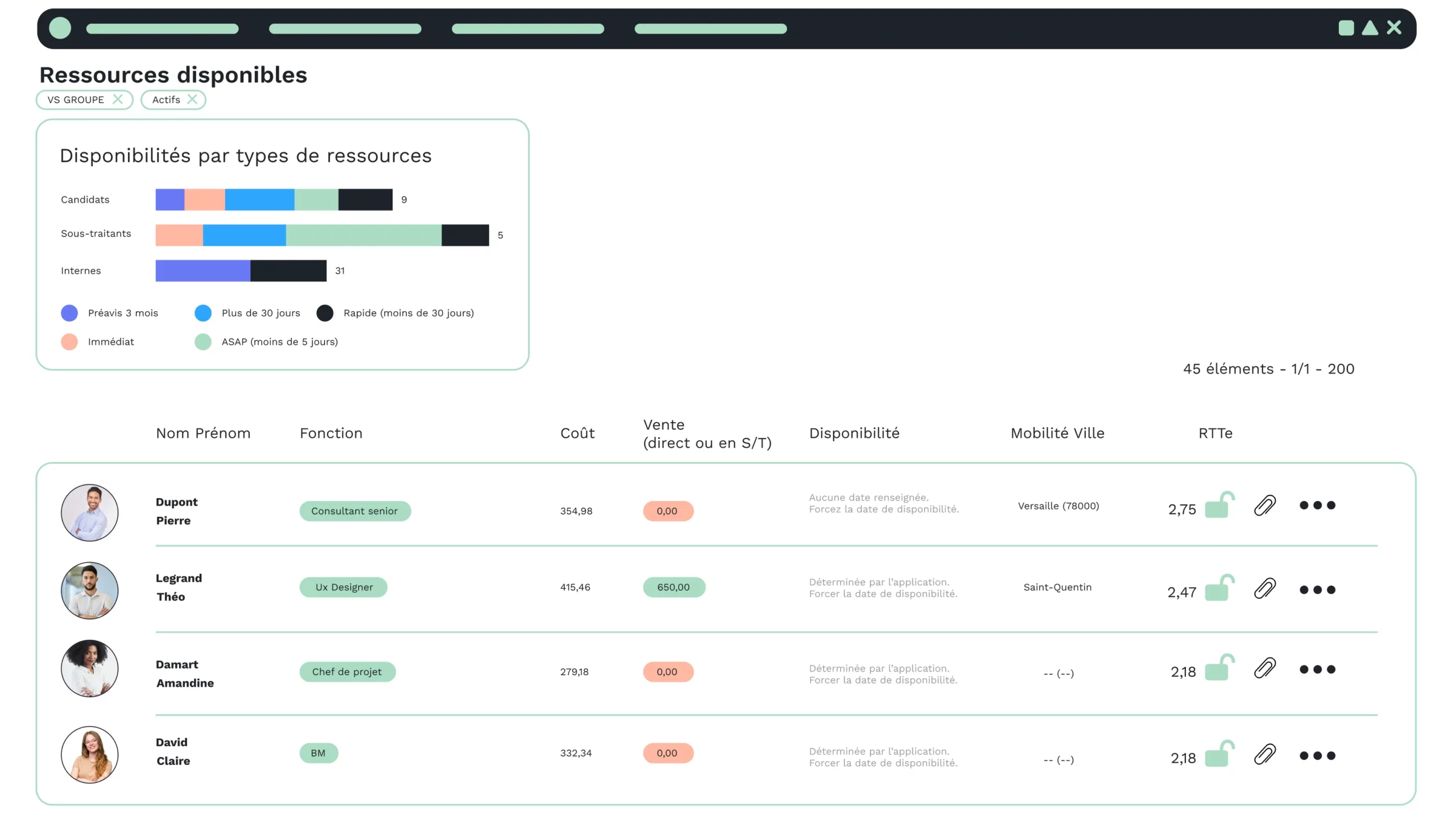
VSPortage is the ERP system developed by Veryswing specifically for umbrella companies. It natively integrates all the features needed for compliant and efficient management of activity accounts.
Full automation of the 7 required elements
VSPortage automates the entire activity account lifecycle:
- Real-time billing → activity account integration: As soon as an invoice is issued or paid, the contractor’s activity account is automatically updated.
- Automatic calculation of charges: employer contributions, employee contributions, management fees… all deductions are calculated based on current rates and broken down in the activity account.
- Allocation to the financial reserve: The system automatically calculates and allocates the required 10 percent based on the type of contract (fixed-term or permanent).
- Generation of the compliant monthly statement: Each month, an activity account statement is generated in PDF format, ready to be sent to the contractor.
Self-Service Access for Your Contractors
VSPortage offers a secure personal space for each consultant, accessible 24 hours a day from any device:
- Viewing the activity account in Real Time
- Complete history of previous months
- Download statements in PDF format
- Salary Estimate Based on Projected Turnover
- Reporting Business Expenses with Supporting Documentation
The result: Your consultants have complete transparency regarding their compensation, which strengthens their trust in and loyalty to the umbrella company.
Guaranteed compliance with the collective bargaining agreement
VSPortage incorporates the provisions of the collective bargaining agreement for umbrella employement from the very outset:
- Automatic regulatory updates: Our teams incorporate every legal or contractual change and deploy it to your instance without any action on your part.
- Alerts for anomalies: The system detects inconsistencies (salary below the collective bargaining agreement minimum, unallocated reserves, etc.) and alerts your teams.
- Comprehensive audit trail: All transactions are tracked and time-stamped, facilitating URSSAF audits or labor inspections.
Integration with Other VSPortage Modules
The activity account integrates seamlessly with the entire VSPortage ecosystem:
- Payroll Module: The activity account directly feeds into the payslip calculation, ensuring data consistency.
- DSN Module: Information from the activity account is automatically included in the nominative social security reports.
- CRA Module: Consultants’ activity reports are automatically fed into the activity account in real time.
- Reporting Module: dashboards for monitoring overall financial guarantees, past-due receivables, provisions, etc.
Frequently Asked Questions About the Activity Account (FAQ)
How often is the activity account updated?
Article L.1254-25 of the Labor Code requires monthly reporting. The contractor must be informed once a month of the entries posted to their activity account. This information may be provided by mail, email, or made available through an online portal.
Does a contractor need to verify their activity account?
The law does not require the contractor to formally approve the activity account. However, it is strongly recommended to implement a system for acknowledging receipt (such as an email with a read receipt or an electronic signature) to prove that the information was properly transmitted in the event of a dispute.
How long should activity accounts be retained?
As a document related to the employment relationship, the activity account must be retained for at least 5 years after the end of the employment contract (statute of limitations for claims for payment of wages). For related accounting documents, the retention period is 10 years.
Can the management of the activity account be outsourced?
Yes, it is possible to entrust the technical management of the activity account to an external service provider (certified public accountant, software vendor, etc.). However, legal responsibility remains with the umbrella company as the employer. The umbrella company must ensure that the service provider complies with regulatory requirements.
What is the difference between an activity account and a payslip?
The payslip and the activity account are two complementary but distinct documents:
- A payslip is the legal document certifying the payment of wages. It details the components of compensation and contributions for the month in question.
- The activity account is a broader financial tracking document. It includes invoiced turnover, cash receipts, accumulated financial reserves, and more. It serves as a management tool for the consultant.
Ready to digitize the management of your activity accounts with VSPortage?
The activity account is much more than just a legal requirement: it is a strategic tool for any umbrella employement company seeking to stand out in a competitive market.
By providing your contractors with full transparency regarding their compensation, you build their trust, reduce disputes, and foster a lasting relationship. Conversely, sloppy management exposes your umbrella company to financial penalties, legal risks, and reputational damage.
Digitizing this requirement using a specialized ERP system like VSPortage allows you to balance regulatory compliance with an optimal consulting experience. It’s an investment that quickly pays for itself through time savings, fewer errors, and greater employee retention.
Request a personalized demo of VSPortage and learn how to automate this legal requirement while providing a seamless experience for your consultants.