

Reading time: 8 minutes
Introduction: Project Profitability—A Strategic Challenge for Operations Managers
In IT services companies (ESN) and consulting firms, managing profitability on a per-project basis is a key strategic lever for ensuring growth, optimizing resources, and enhancing customer satisfaction. In an environment where margins are often tight and schedules complex, operations managers must be able to rely on reliable data and clear metrics.
In this article, we offer a practical, proven method for better managing profitability on a project-by-project basis: learn about the pitfalls to avoid, the tools to use, and the best practices to implement.
What is profitability per project in IT services companies?
Project profitability measures a project’s ability to generate profit after deducting its direct costs (consultant time, purchases, and specific operating expenses). It differs from overall profitability in that it allows you to identify precisely which projects (or types of clients) are profitable.
Why it’s important:
- Tracking profitability by project guides strategic decisions. You can identify the most profitable types of projects, as well as the client profiles to prioritize and the most profitable contracting models (time-and-materials or fixed-price).
- This refined monitoring process makes it possible to identify high-risk projects.
- It highlights the actual margins, which sometimes differ from the forecasts.
Example: A project with a high Average Daily Rate may seem profitable, but if it requires the services of a hard-to-find senior consultant or involves frequent travel back and forth, its actual margin may be low or even negative.
Why is it difficult to manage profitability on a project-by-project basis?
In IT services companies or consulting firms, several challenges can hinder the tracking of profitability by project:
- Lack of real-time visibility: Data is scattered across various tools (Excel, CRM, ERP, timesheets). Sometimes, the data is even inconsistent and requires extensive research to correct.
- Ineffective planning: This is one of the most common problems in service companies. Without a cross-functional planning tool, resources may be overutilized or underutilized. Operations managers are often faced with allocation conflicts.
- Incomplete or unreliable data: Due to data entry errors or delays in reporting information (such as the submission of activity reports, for example), it is impossible to access reliable, up-to-date data.
- Organizational silos: Without a centralized solution, each department operates in isolation. The lack of coordination between sales, production, back office, HR, and finance leads to inefficiencies in project management and reporting.
“We weren’t able to anticipate the overload on certain projects, which gradually eroded our margin over several months without us even noticing.”
Etienne H., Director of Operations at an IT services company with 80 employees
The Consequences of Poor Management
Executives at IT services companies and consulting firms know this all too well: without tight control, the company’s overall profitability could ultimately be affected.
Among the most common mistakes, keep these in mind:
- Underestimation of indirect costs or periods between contracts
- Inadequate forecasting of resource needs
- Lack of real-time monitoring of indicators
- Lack of coordination between the sales, HR, and production teams
An unprofitable project is often the tree that hides the forest.
In both the short and long term, this threatens not only your company’s financial health but also its operational excellence.
Loss of margin or negative profitability
- Loss-making projects: If time spent or costs aren’t tracked properly, a project that appears to be “profitable” may actually be costing you money.
- Failure to anticipate budget overruns: Without careful monitoring, you won’t realize until it’s too late that a project is exceeding its projected costs.
The result: Your net income declines, and your cash flow becomes more vulnerable.
Underutilization or Overuse of Resources
- Understaffing: Consultants who aren’t assigned to projects means “reduced billings” and, ultimately, “a loss of turnover.”
- Overwork: Conversely, some employees may be overworked without this leading to improved profitability. On the other hand, your company’s reputation and your employees’ well-being are jeopardized, with an increased risk of employee turnover.
The consequences are both personal and organizational: your teams are demotivated, and your company loses efficiency.
Lack of visibility for decision-makers
- Without reliable metrics (Average Daily Rate, utilization rate, project profitability rate, etc.), your strategic decisions (hiring, investment, client prioritization) are based on incomplete data.
- It becomes difficult to prioritize profitable projects or identify low-profit customers. This can even affect your sales team, which may not know which type of prospect to focus its efforts on.
In the long run, you risk making decisions based on guesswork and making the wrong choices.
Uncontrolled lead times and customer dissatisfaction
Unfortunately, it is your customers who end up “paying” the price for your lack of oversight.
- Ineffective time management or poor handling of deliverables affects the quality of services.
- This can lead to tensions with customers, or even contractual penalties.
Your customers’ trust is eroding, and you run the risk of contracts not being renewed.
Impact on HR and Management
- Employees working on poorly defined or unprofitable projects may feel a loss of purpose or become frustrated.
- Without clear metrics, it becomes difficult for managersto evaluate individual or team performance.
You are facing increased employee turnover and a deterioration in the workplace atmosphere.
Risks in the Event of an Audit or Fundraising
- A lack of traceability or reliable metrics on project profitability is a red flag for investors or partners.
- In the event of a buyout or financial audit, this could cause the company’s valuation to plummet.
To avoid all these pitfalls and ensure your company’s long-term viability, you need to implement several strategies to manage profitability on a project-by-project basis.
Key Factors for Effectively Managing Project Profitability
1. Centralize key data
Use an ERP system like VSActivity to centralize:
- Times gone by,
- Resource allocations,
- Tracking of direct project-related expenses (purchases, travel expenses),
- Business data (Average Daily Rate, contracts, forecasts).
A single reference system enables reliable and dynamic management.

2. Track the right KPIs
- Project Margin = Billed Revenue – Direct Costs / Billed Revenue
- Budget Variance = Initial Forecast vs. Actual
- Workload vs. Capacity = Number of days allocated vs. number of days available
- Productivity = Billable time / Total time
Monitor these metrics regularly, with weekly or monthly reviews depending on the type of project.
3. Optimize staffing
- View availability 4–8 weeks in advance
- Allocate rare or expensive profiles strategically
- Avoid projects that require a lot of coordination but do not generate corresponding billing
Staffing is often the primary driver of profit margins: making effective use of your consultants is more profitable than signing a new contract.
What role do chief operating officers play?
Project management isn’t just a matter for financial controllers. Operations managers play a key role in:
- Facilitate project reviews focused on metrics and variances
- Implement proactive (rather than reactive) monitoring
- Cross-reference sales, HR, and financial data to make comprehensive decisions
- Evolving Planning and Billing Practices
Tools to Adopt for Real-Time Management
A good management tool should enable:
- Real-time tracking by consultant and by task
- Multi-project assignment
- Automatic Margin Calculation
- Alerts regarding irregularities (expenses, budget variances)
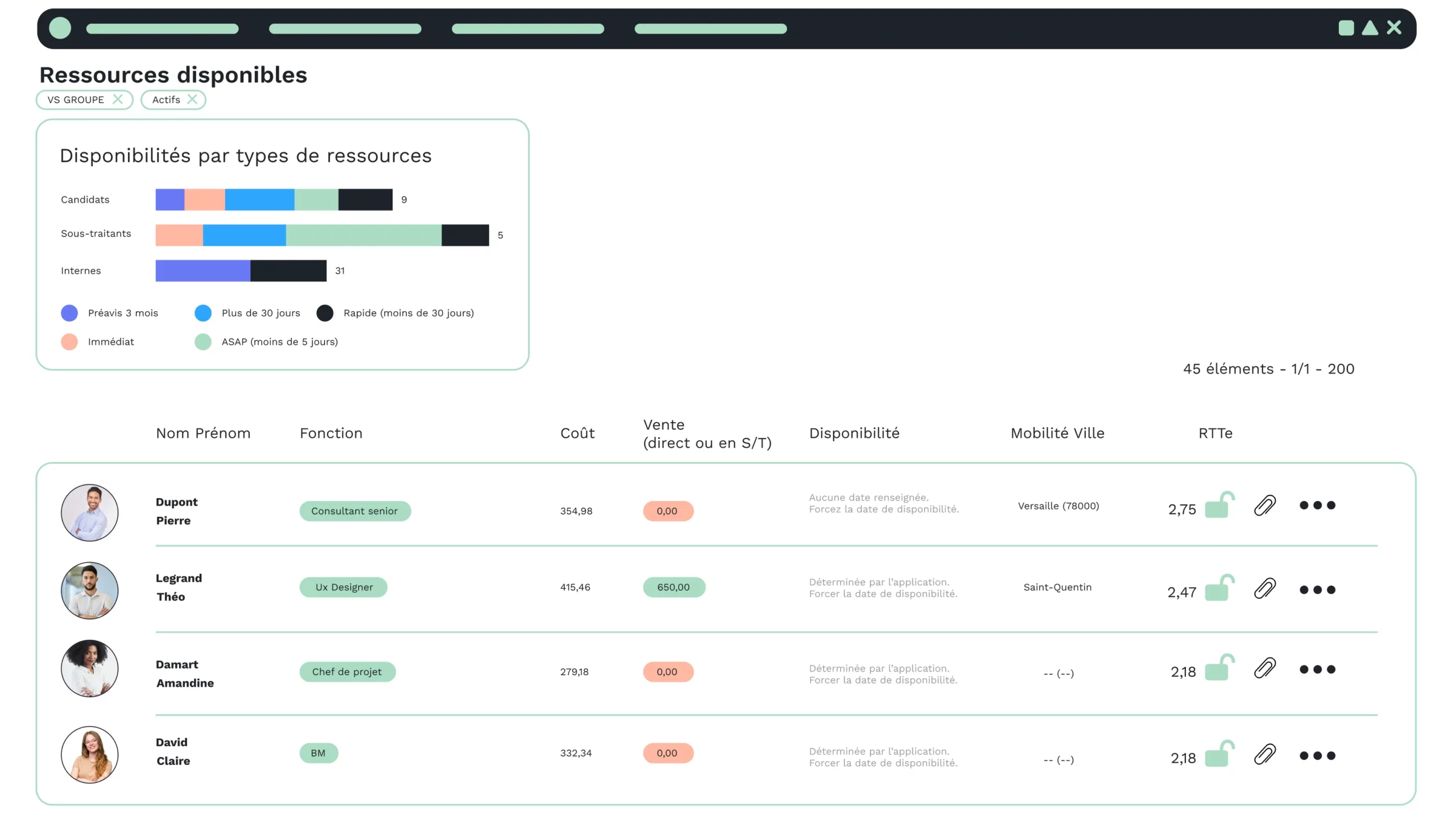
VSActivity offers a platform dedicated to project management in IT services companies: real-time data consolidation, visibility into staffing, project-level margin calculations, and customized alerts.

Digitize your processes with VSActivity and streamline your project management
Project profitability is the key metric for IT services companies and consulting firms seeking sustainable growth without sacrificing their margins. With VSActivity, the ERP system designed for service companies, you have a powerful tool for managing the profitability of each project:
- Centralize your data on a single platform and manage access rights by user
- Optimize consultant staffing with a comprehensive view of schedules, resources, and projects.
- Digitize and automate activity report processes : digital data entry—even from a smartphone—automatic reminders for late payments, and an automated approval process.
- Track your KPIs in real time using project-based dashboards.
- Improve sales and accounting productivity and reduce billing lead times to strengthen your cash flow.
VSActivity is a 360° ERP software solution that also integrates CRM and HRIS capabilities. Designed for IT services companies and consulting firms, it enables agile and efficient project management.
Schedule a demo with one of our experts and get personalized advice on managing your business.