

Reading time: 5 minutes
Freelancers looking for an umbrella company solution are primarily concerned with management fees. But it’s not just a number to be displayed to reassure a prospective employee.
It is this margin that funds the entire structure of your umbrella company: administrative staff, management tools, insurance, and financial guarantees. If it is not properly calibrated or monitored over time, it can undermine your profitability in the long term without the problem being immediately apparent.
What the management service is intended to fund
Before setting a rate, it is necessary to list precisely what the management fees are intended to cover.
In exchange for this fee, an umbrella company provides each consultant under its umbrella with a range of services that includes, at a minimum:
- Drafting and managing the employment contract (permanent or fixed-term contract under the portage salarial arrangement), in accordance with the collective bargaining agreement for portage salarial companies (IDCC 3219).
- Managing the commercial contract between the contractor and their client, and maintaining relationships with mandatory social security agencies (health insurance, old-age benefits, family allowances, training, supplemental retirement benefits, and life insurance).
- The Single Hiring Declaration filed with URSSAF.
- Billing clients in the outsourced program and managing late payments.
- Preparing pay stubs and maintaining the monthly activity log.
- The tools provided to the portfolio company to track its business activity (portal, mobile app, business account).
Each umbrella company may offer optional services in addition to this basic package (legal support, training, negotiated health insurance, etc.), which justify a higher rate if they are actually used. It is this scope of services that should guide your decision-making.
How to Set Your Management Fee Rate
There is no universal rate: practices vary significantly from one umbrella company to another depending on the scope of services included, the company’s market positioning, and its cost structure.
Three factors should guide the calibration rather than simply adopting a market figure as is:
- Your fixed overhead costs (administrative staff, tools, rent, financial guarantee) relative to the volume of active contractors: the larger your contractor base, the more you can—for the same level of service—absorb these costs at a lower rate.
- The actual scope of services included in the package: a higher rate is commercially justified if it covers services that the contractors value (legal support, training, advanced tools) and not just basic administrative tasks.
- Your competitive positioning: a rate in the lower-middle range of the market can be a selling point, but only if it remains consistent with your break-even point. That’s why it’s important to calculate your actual margin before setting a promotional rate.
This calibration should be documented internally: it allows you to justify a rate adjustment or to challenge a rate that has been passed down from a market practice that has never been recalculated since the company was founded.
Calculating Your Actual Margin: An Example
The management fee rate is only the first step in the calculation.
To effectively manage the profitability of your EPS, you need to distinguish between two levels of margin:
- Management Margin = (Management Fees Deducted / Revenue Billed by Affiliates) × 100
This is the “gross” rate—that is, the one typically listed in your price list. However, it does not reflect your organization’s actual profitability once operating expenses have been deducted.
- Company Net Margin = Operating Margin − Overhead Expenses (internal salaries, tools, insurance, financial guarantees)
Here is a generic example to illustrate the mechanism, using deliberately neutral orders of magnitude (which you should replace with your own data for an actual calculation):
- 50 active clients, with average billed revenue of €8,000 per client per month, for a total consolidated monthly revenue of €400,000.
- Management fees deducted from this amount: gross management margin expressed in euros.
- Monthly operating expenses for the company (administrative staff, equipment, insurance, financial guarantee): to be deducted from this gross margin to arrive at the actual net margin.
The value of this exercise lies not in the absolute result but in the mechanics: a reported operating margin may seem comfortable as a percentage, yet leave a very narrow net margin once fixed costs are allocated across the actual volume of active clients. That is why the ratio of active clients (and not just the number of clients under contract) must be included in the calculation.
What the rate must cover, step by step
The following table provides a general guide to how the scope of included services tends to change based on the advertised rate. This framework will help you determine your own positioning:
| Level | Services Generally Included |
| Administrative Framework | Contracts, invoicing, payroll, social security contributions, monthly activity report. These are the minimum legal and operational requirements. |
| Enhanced Support | Administrative infrastructure + first-level legal support, web portal and mobile app, proactive payment reminders. |
| Premium Services | Enhanced support + subsidized training, negotiated health insurance, sales networking, and dedicated consulting. |
Documenting this type of rate schedule internally allows you to justify your rate to a client who is comparing offers. It is also a useful tool for objectively challenging a rate increase or decrease, rather than simply following a market practice that has never been recalculated since the company was founded.
Managing Your Rate Over Time
A rate set once is not intended to remain fixed indefinitely.
Three indicators should prompt a review:
- a declining net margin despite a stable operating margin
- a declining percentage of active subscribers, which spreads your fixed costs over a smaller volume
- the addition of services that objectively justify a revised rate.
We provide details on the method for monthly monitoring of these metrics (margin, DSO, revenue per employee) in our guide: Managing the Financial Performance of an umbrella company.
The Trade-off Between Margin and Attractiveness
For umbrella companies, the management fee rate remains one of the primary criteria for comparing different umbrella companies.
A high rate can therefore hinder the recruitment of new contract workers. This is a risk that must be balanced against the need for profitability. Transparency about exactly what your rate covers remains the best way to balance the two: we discuss this in more detail in our article on the key factors for attracting employees under a portage arrangement.
VSPortage: Calculate and Manage Your Administrative Expenses Without Attachments
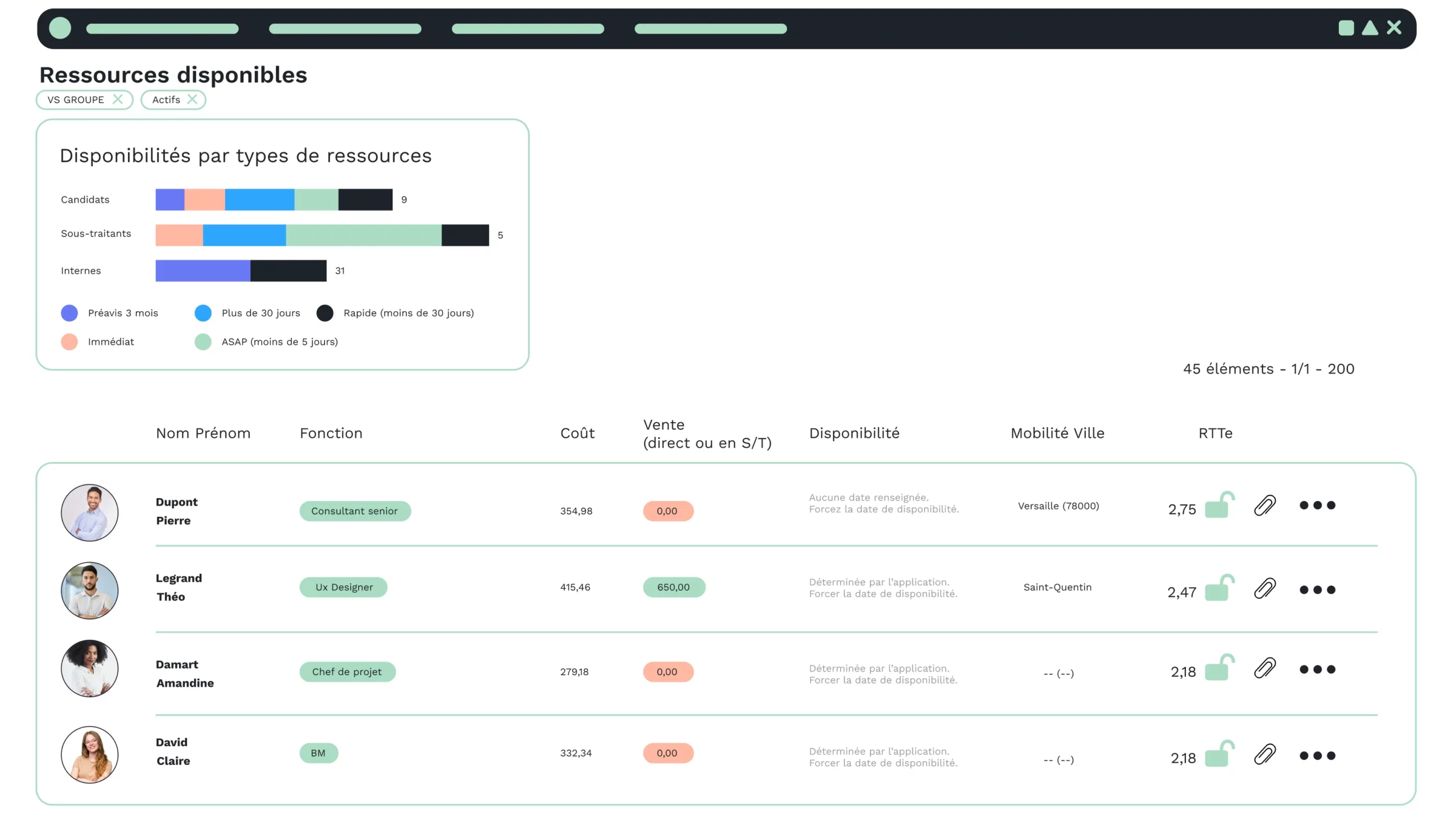
VSPortage automatically calculates management fees based on the revenue billed by each contractor, according to the rules specific to each contract. Your management margin and net margin are available in real time in your financial reports, without the need for manual consolidation across multiple Excel files.
Frequently Asked Questions About Management Fees in Portage Salarial Services
Does the management fee rate have to be the same for all portfolio companies?
Not necessarily. Some umbrella companies apply a sliding-scale rate based on the contractor’s revenue or a different rate depending on the service tier selected. The key is that the rule applied must be consistent, documented, and explainable at any time, including during an audit.
Should you set your rate to match that of your competitors?
Aligning your pricing with market rates without first calculating your own net margin is risky: a competitive price that does not cover your fixed costs undermines your profitability, even if it works from a sales perspective. The net margin calculation described above must be performed before any pricing decision is made.
How often should you review your management fee rate?
There is no required frequency, but a review at least once a year—typically at the end of the fiscal year—is recommended to ensure that the rate remains consistent with changes in your overhead costs and the number of active contractors. More frequent reviews are warranted during periods of strong growth or significant internal hiring.