

Reading time: 4 minutes
Why Deferred Revenue and Accrued Revenue Are Essential in IT Services Companies and Consulting Firms
In IT services companies and consulting firms, “Accrued revenue” and “Deferred Revenue” are often seen as somewhat obscure accounting maneuvers that are handled in a rush… right before the balance sheet is prepared.
And yet, when managed effectively, they can become powerful tools for operational, financial, and strategic management.
That’s the whole point of this first Verytalk, our webinar hosted by Marjory Mahler (Customer Success Manager at Veryswing), Gaëlle Alcaraz Jimenez (sales expert), and Iulia Suvagau (Veryswing Account Manager and former management controller), who shared methods, insights, and best practices with more than 70 participants.
What is the difference between a Deferred Revenue and an Accrued revenue?
- Accrued revenue: “Invoice to Be Issued” refers to a sale that has been completed but not yet invoiced. Example: Project completed on 12/29; invoice issued on 01/05.
- Deferred Revenue: it refers to an invoice issued for a service that has not yet been fully rendered. Example: An annual contract billed in July, with services provided through the following June; as of December 31, a portion must be recognized as deferred revenue.
In service companies, these situations are common: time-and-materials assignments, fixed-price projects, complex contracts… The discrepancy between what was delivered and what was billed is inherent to the business model. And that’s exactly where it all comes down to!
Two Methods for Calculating Outstanding Balances
You can rely on two main valuation methods:
1. Based on actual production
Ideal for cost accounting, it is based on the hours entered and approved, multiplied by the Average Daily Rate.
2. Project Progress
Often used for fixed-price contracts, this calculation method is based on a progress rate defined by the project manager and provides a more qualitative view of actual progress.
💡 In any case, monitoring should be monthly (ideally), structured, and integrated into a team-wide process. Sales, operations, management, and projects: everyone is involved.
Why Keep a Close Eye on Deferred Revenue and Accrued Revenue?
Accrued Revenue/Deferred Revenue have a direct impact on:
- The financial statement (and thus for tax purposes)
- Cash flow (time lag between collection and production)
- Financial indicators (profit, margin, working capital, etc.)
- Relations with the CAC or the tax authorities
But beyond the accounting issues, they reveal above all:
- Operational bottlenecks
- Tensions between departments (Sales, Project Manager, Business Development)
- Problems with organization, validation, and management
A dashboard for managing… and planning ahead
At Veryswing, we believe that Accrued revenue/Deferred Revenue figures aren’t just numbers to be recorded. They are tools for structuring, decision-making, and ensuring the reliability of forecasts.
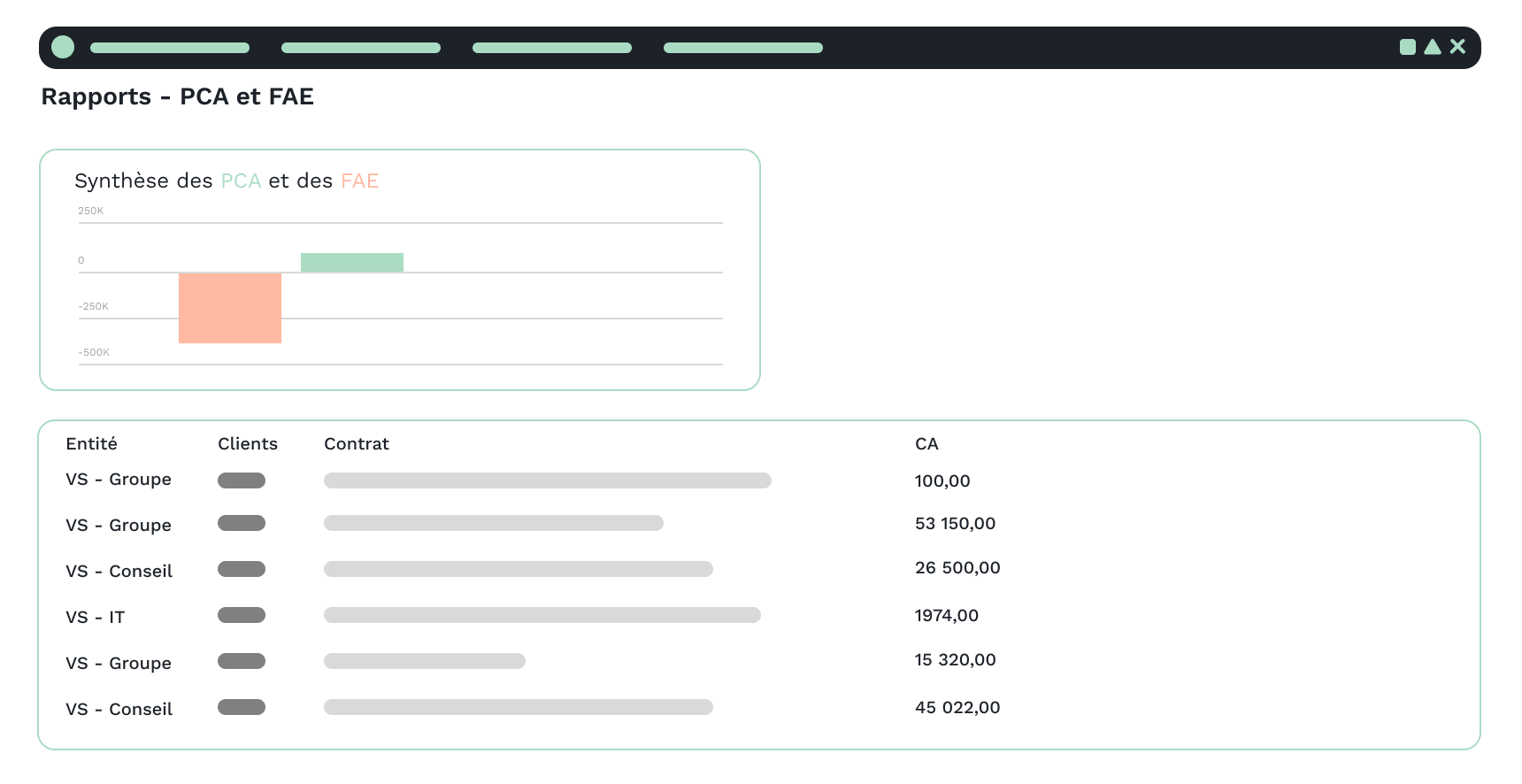
We recommend the following key steps:
1. Structuring Internal Processes
Objective: To ensure that Accrued Revenue/Deferred Revenue are anticipated rather than simply endured.
- Standardize the validation steps (activity report, PV, deliverables).
- Establish a schedule for reporting information (weekly or at the end of the month).
- Assign responsibility to the various stakeholders: consultant → project manager → sales administrator.
- Integrate automatic alerts or reminders into VSA and VSP.
2. Anticipate cash flow discrepancies
Goal: To avoid finding out at the end of the month that we’ve produced goods without receiving payment.
- Use Accrued Revenue-Deferred Revenue to adjust cash flow forecasts.
- Identify “high-risk” projects (delays, specific commercial terms).
- Adjust billing schedules to smooth out cash flows (interim billing, advance payments, etc.).
- Monitoring accrued revenue on a monthly basis makes it possible to anticipate cash flow peaks and troughs.
3. Adjust project management
Objective: To make Accrued Revenue-Deferred Revenue an operational indicator rather than a purely accounting one.
- If there are recurring accrued revenues on a project → there is an issue with validation, contract management, or organization.
- If Deferred Revenue is never finalized → service not launched? Delivery issue? No customer follow-up?
- Link production metrics to billing metrics.
4. Record transactions and avoid unpleasant surprises at year-end
Objective: To ensure the reliability of the figures and reassure management.
- By keeping track of things on a monthly basis, closing out the month becomes a formality, not a race against the clock.
- The sales representative arrives prepared with all the supporting documents.
- The CFO and the auditors have an accurate picture of the business.
- That is the difference between reactive management and proactive management.
All while adhering to accounting principles (prudence, separation of fiscal years, justification of provisions).
And to do all that without spending hours on it, a good ERP system becomes an indispensable ally.
What VSActivity Actually Lets You Do
The ERP software VSActivity, designed for IT services companies and consulting firms, allows you to:
- Centralize time tracking, assignments, invoices, contracts, and supporting documents
- Automate Accrued Revenue/Deferred Revenue Calculations
- View project balances in real time via monitoring dashboards
- Prepare for the end of the fiscal year with greater peace of mind
- Collaborate More Effectively Through a Cross-Functional View of Progress
- Easily provide justification to the CAC or the tax authorities
And above all: improve collaboration among teams.
Key Features of VSActivity for Accrued Revenue/Deferred Revenue Management
| Key Feature | Impact on the Management of Outstanding Balances |
| Time Tracking and Progress Monitoring | Accurate Valuation of Accrued Revenue/Deferred Revenue on a Monthly Basis |
| Automated Calculation of Provisions | No more manual errors or the stress of month-end closing. |
| Real-time reporting on financial metrics | Anticipate and correct deviations as soon as they occur. |
| Document Centralization | Easily prepare your supporting documentation for the CAC and the tax authorities. |
| Collaborative Management of Validations | Streamline the process by involving all stakeholders. |
FAE / Deferred Revenue: A Collective Responsibility
Sales, management, CFO, project managers, sales representatives, consultants… everyone has a role to play:
The sales team establishes the billing terms during the pre-sales phase
It negotiates billing terms that result in a time lag between production and accrued revenue (
). Sales representatives are responsible for providing complete contract information
before the project begins. They affect project work in progress by:
- Offering management services, flat-rate pricing, or hybrid projects to prospects and clients
- Organizing project phases and establishing an invoicing schedule for fixed-price contracts
- By including (or not including) a provision for risks (PPR)
- Management analyzes and makes decisions.
The project manager updates the progress report every month
It fulfills the promises made during the pre-sale and by the sales team regarding margins and service quality
.
The project manager influences the project backlog by:
- Selecting internal and external resources throughout the project;
- As the project progresses and by sharing this information with the Finance Department;
- Keeping track of what remains to be done;
- Gathering the information needed for billing (work orders, customer agreements, etc.).
IT Consultants Affect the Billing Timeline
By reporting their monthly hours in the activity reports (CRA), each resource
affects project work in progress by:
- Capturing high-quality data: complete, accurate, consistent …
- In accordance with the client’s billing processes: signed client activity report, deliverables, etc.
- Submitting their activity reports no later than Day 1 of the following month
The Sales Administration department coordinates, notifies, and manages
As a cross-functional role by nature, her position plays a central role in accrued revenue in particular.
Working with the sales team, she reviews contractual documents and configures rules and conditions for
billing. Working with the Project Manager, she ensures consistency in project progress and collects deliverables and meeting minutes
. Working with consultants,the Sales Administration team monitors the entry of activity reports and the provision of production supporting documents
.
Sales and Operations Planning (SOP) affects project backlogs by:
- Identifying risks and notifying the CFO;
- Creating proactive follow-up processes;
- Providing justification for advance payments and billing delays;
- Optimizing billing every day.
A well-positioned Sales Administration department
makes it possible to escalate field-level roadblocks to the right contact
and to fuel a cycle of continuous improvement.
This cross-departmental collaboration streamlines processes
and directly helps boost cash flow.
The Finance Department ensures reliability, provides justification, and closes the books
The Administrative and Financial Department pays particular attention to monitoring project balances.
The DAF has an impact through:
- Regarding the choice of methods for calculating Accrued Revenue-Deferred Revenue,
- Regarding the decision to release the FAE-Deferred Revenue,
- Regarding the decision to use the Provision for Risks (PPR),
- On the Regular Auditing of Accrued Revenue-PCAs.
In conclusion: Outstanding balances are an indicator of your company’s maturity
Accrued revenue and deferred revenue are neither good nor bad. It all depends on how they are monitored, utilized, and integrated into overall management.
At Veryswing, we help service companies better organize their project portfolio management every day through our industry-specific ERP system, VSActivity.
➡️ Let’s talk about it! Schedule a meeting with our team to see how VSActivity can be tailored to your processes:
👉 Request a demo